This case study breaks down our approach to custom tour website design: how we turned a client’s raw assets into a website built to generate inquiries and bookings.
It all started with a simple email: “Hey bro, can you build a website for my business?”
Because this came from one of our absolute favorite long-term clients, we jumped right in with immediate energy and strategic vision.
When designing a website for high-ticket experiences—like custom luxury tours or specialized travel—the goal isn’t just to look pretty. The goal is to build immediate trust and guide prospective guests seamlessly from interest to booking.
Key Takeaways from Our Custom Tour Website Design Project
- The client arrived with a solid starter pack: 20 wireframes, a logo, 3 brand colors, 2 design patterns, 6 photos and 4 videos.
- For high-ticket travel, a website’s job is to build trust and guide guests from interest to booking.
- We set five design priorities: immersive media, safety guidelines, activity breakdown, tiered offers and guide introductions.
The Starter Pack: What We Worked With
At kickoff, the client provided a solid set of foundational assets:
- 20 initial wireframes mapping early ideas
- 1 brand logo and 3 brand colors
- 2 core design patterns
- 6 high-resolution photos and 4 promotional videos
Compared to starting from scratch with only a brief and a chat transcript, this was a fantastic starter pack. However, converting raw assets into a fully functional, high-converting digital platform requires structured UX/UI design and clear messaging hierarchy.
Our primary mission was clear: turn these assets into a full-fledged website capable of consistently generating inquiries and bookings for custom tours.
Planning a website for tours or other high-ticket experiences? Tell us about your project or browse our recent work.
Setting Priorities for Custom Tour Website Design: Intuitive UX and Conversion Strategy
When building web experiences for travel and tour operators, we prioritize intuitive navigation and user-friendliness. These core principles directly govern user behavior, time-on-site, and ultimately, conversion rates.
Our Philosophy: A website isn’t the business itself—it is the bridge between the customer and the experience. Our job as a design studio is to build the fastest, most comfortable pathway for users to get what they want.
Designing for High-Risk & High-Involvement Purchases
The purchase decision timeline varies dramatically across industries. When buying a low-cost item, decisions are impulse-driven. But when purchasing a custom tour, clients encounter high consideration, perceived financial risk, and uncertainty.
They aren’t just buying a travel service—they are investing in a memorable life experience.
To eliminate purchasing friction and build instant authority, we established five non-negotiable design priorities for the layout:
- Immersive Media Integration: Showcase real tour experiences using authentic, high-quality photos and videos.
- Safety & Visitor Guidelines: Clearly communicate key safety protocols, physical requirements, and visitor expectations upfront.
- Activity Breakdown: Provide clear, scannable visual summaries of available activities and itineraries.
- Tiered Offer Architecture: Structure multi-tiered offers tailored to different target audience personas and tour formats.
- Guide Introductions: Humanize the business by featuring local guides to foster trust before the customer books.
And that’s when the real design sprint began…
End of Part One
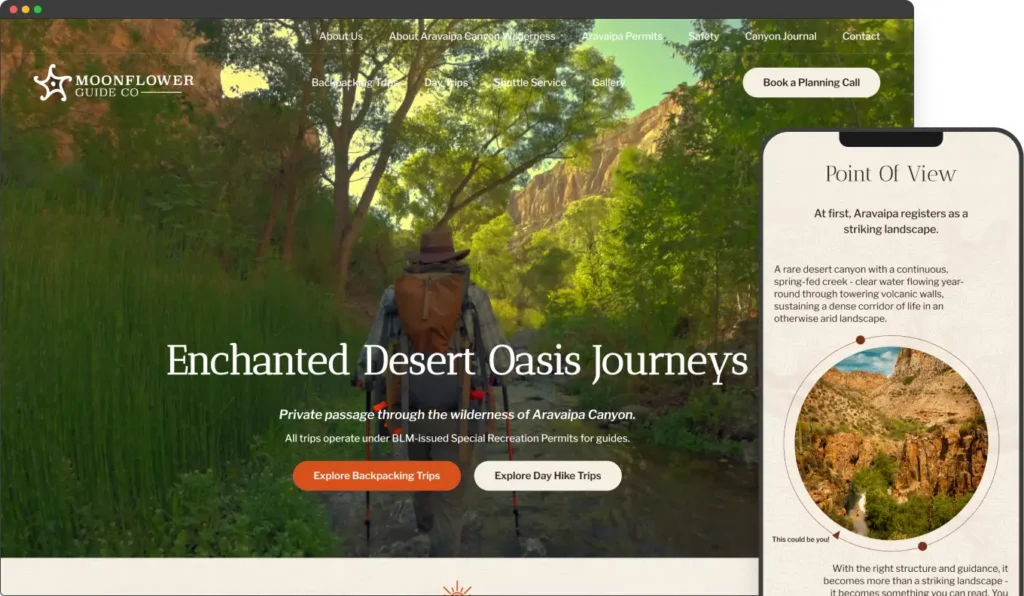
Looking to build a high-converting web platform or elevate your brand visual identity? Explore our design services or send us a project note to get started. You can also see the result live: Moonflower Guide Co.
Frequently Asked Questions
The client provided 20 initial wireframes, 1 brand logo and 3 brand colors, 2 core design patterns, 6 high-resolution photos and 4 promotional videos.
We set five priorities: immersive media integration, safety and visitor guidelines, an activity breakdown, a tiered offer architecture, and introductions to the local guides.
A custom tour is a high-consideration purchase with perceived financial risk and uncertainty. Guests are investing in a memorable life experience, so the website has to remove friction and build authority before they book.
The goal was to turn the client’s assets into a full-fledged website that consistently generates inquiries and bookings for custom tours.